

Kratovo man stabs police officer mid-intervention: prosecutors want the 40-year-old detained
15.09.2026


15.09.2026

15.09.2026

15.09.2026
15.09.2026
15.09.2026
15.09.2026

15.09.2026

14.09.2026

13.09.2026

15.09.2026

15.09.2026

14.09.2026

15.09.2026

15.09.2026

15.09.2026

15.09.2026

14.09.2026

13.09.2026

15.09.2026

15.09.2026

15.09.2026

15.09.2026

15.09.2026

14.09.2026

09.03.2026

27.02.2026

19.02.2026

15.09.2026

14.09.2026

14.09.2026

23.04.2026

23.04.2026

12.04.2026

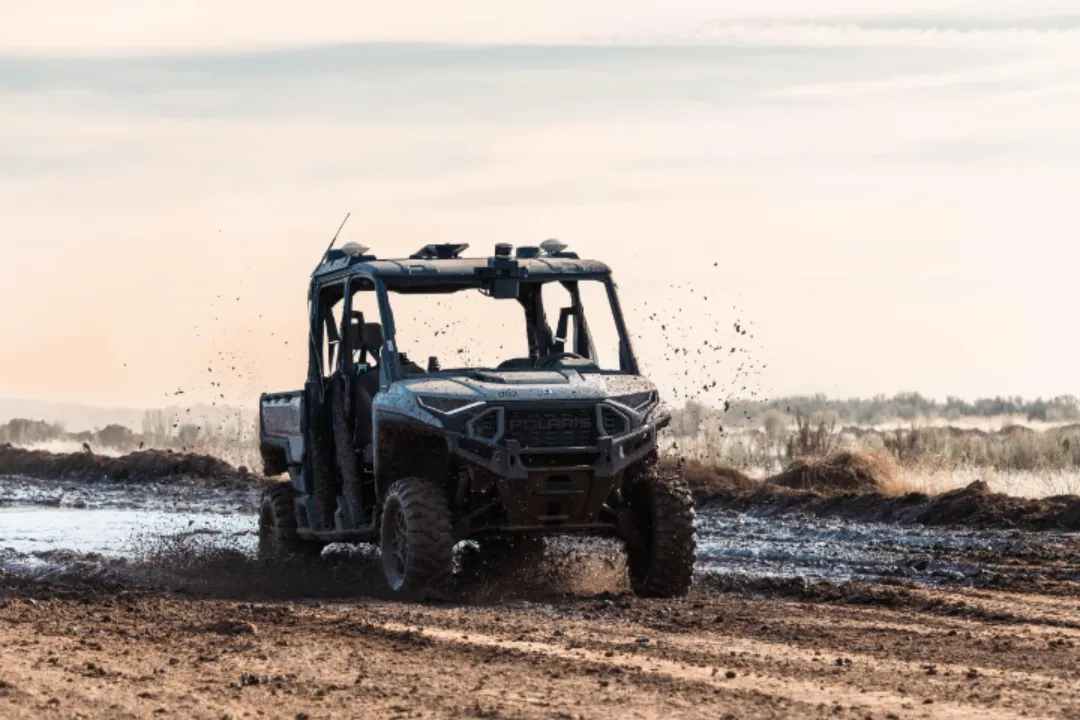
The future of warfare didn't arrive with a ceremonial launch, but through the mud of the Ukrainian front. The American company Forterra revealed that more than 100 of its autonomous vehicles have already been deployed in Ukraine's combat zones for nine months - the largest combat deployment of self-driving ground vehicles by an American defense company to date. The public only found out now.
The reason for the ground robots is brutally simple. Drones created a front where, as US Sergeant Corey Wilkens puts it, "there's nowhere to hide" - any movement in the open means a target for explosive-carrying aircraft, artillery, and mines. So supply, ammunition, and the evacuation of the wounded are increasingly left to machines. The Lancer vehicles, built on Polaris off-road vehicles with their own sensor system, carry up to 750 kilograms of cargo - three times more than Ukraine's battery-powered robots - and got a key field upgrade: a Starlink antenna.
The numbers from nine months of work: over 4,000 kilometers covered across more than 1,100 missions, about 350 tons of cargo transported, and 52 evacuations of the wounded. A Ukrainian soldier, whose identity is protected, is blunt: "This is the most important unmanned vehicle in Ukraine. We're dying to get more." Some vehicles have been lost - most often stuck in deep mud, where Russian forces pick them off at leisure.
But behind the marketing shine lies a sobering truth: in real combat the vehicles are mostly operated by soldiers remotely. The autonomy knows how to drive across terrain, but it doesn't know how to recognize an enemy and react - and on the front that's exactly the difference between a tool and a toy. Forterra, with over 500 million dollars in investment behind it, is now combining self-driving-car algorithms with generative AI so the vehicles can "think" in unforeseen situations. Ukraine, like it or not, has become the world's largest test lab - and the lessons from that lab will be bought tomorrow by armies that have never seen mud.
The latest 10 news from this category
A scientist at the same company puts the probability of human extinction above 10 percent within the next decade. The...
The president called in while the event was running, and the man who makes the chips answered that there would...

No virus attached, no suspicious file. Just a box that looks like the "I am not a robot" check and...
A researcher quit because the firms are gambling with our lives. Instead of denying it, Anthropic confirmed it - with...

Write a sentence, get a game. Until now it worked only in New Zealand, now in Belgrade too. Creators on...

When the two biggest firms in an industry ask for rules on how fast anyone may run, the rules rarely...

Not a single password fell. What fell was the assumption that a request from a government domain is automatically a...
The biggest names in mathematics have signed a letter against the AI labs. The dispute is not whether the machine...

Five campaigns, 200 million exchanges, and the defences fell to a request for a Japanese translation. The industry that harvested...

The hackers were inside for a whole year. The company confirmed it only after a journalist found his own licence...
This site uses cookies - is that okay? Learn more
Be the first to know when Metla launches something new
Leave your email and we will write when there is a new guide or something new on Metla.
