Шест години лажни категории во возачки дозволи од шалтер во МВР: обвинети шестмина, уште 21 лице под истрага
21.09.2026


21.09.2026

21.09.2026
21.09.2026

21.09.2026

21.09.2026

21.09.2026

21.09.2026

20.09.2026

20.09.2026

21.09.2026

21.09.2026

20.09.2026

21.09.2026

21.09.2026

21.09.2026

21.09.2026

20.09.2026

19.09.2026

21.09.2026

21.09.2026

21.09.2026
21.09.2026

21.09.2026

21.09.2026

09.03.2026

27.02.2026

19.02.2026

20.09.2026

19.09.2026

18.09.2026

23.04.2026

23.04.2026

12.04.2026

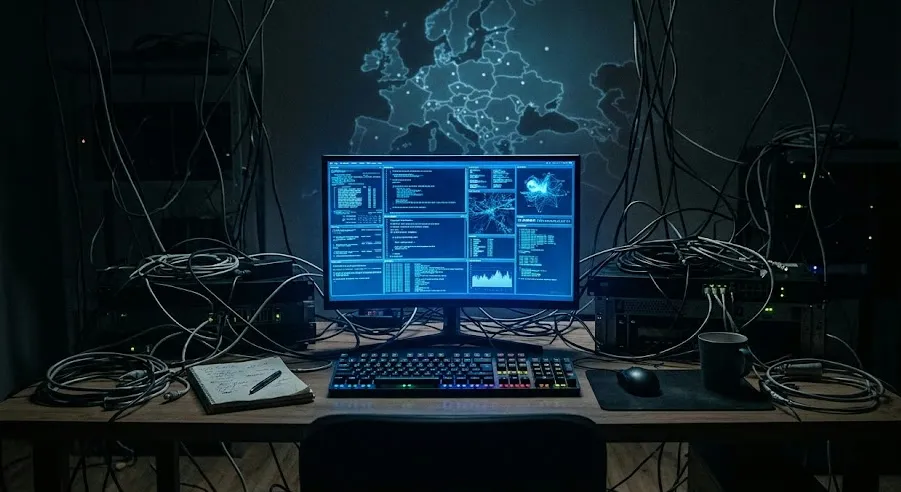
European intelligence services have pieced together something they long suspected and are now documenting: a coordinated hybrid campaign through which Russia is trying to destabilise Europe. Not with tanks, but with fires, sabotage, bots and paid amateurs - a method that's cheap, hard to prove and with enormous reach.
The numbers are striking. The head of German intelligence, Martin Jager, said at the Munich Security Conference that "Moscow today has 60,000 intelligence operatives around the world, not counting informants." In two years, the Polish security service ran more counterintelligence investigations than in the previous three decades.
A two-tier model
The system works on two levels. The first is "single-use agents" - amateurs recruited via Telegram from Russian, Belarusian and Ukrainian-speaking areas. "Extremely cheap, hard to prove, and the reach can be enormous," says a Polish security official. The second level is professional sabotage cells, structured like organised crime, with former soldiers, police officers or mercenaries from Wagner.
The examples aren't theoretical. In Poland, the fire at the Marywilska 44 shopping centre in Warsaw was, as prime minister Donald Tusk put it, "with certainty ordered by the Russian secret services" - three Ukrainians were jailed. Then came an explosion on the Warsaw-Lublin railway line, twenty Russian drones in Polish airspace and three Russian MiG-31s breaching Estonian skies. In Germany, 320 suspected sabotage attempts in 2025 alone.
Alongside the physical attacks runs the information war - bots on social media, Belarusian state radio in Polish, propaganda channels deepening divisions over Ukrainian migrants and the financing of the war. The goal is always the same: to break European support for Ukraine from the inside.
There's good news too. A full 86 percent of Poles see Russia as a threat - the highest in the region - which limits the power of the propaganda. But researchers warn the operations will only intensify ahead of Poland's 2027 parliamentary elections. "Hybrid operations continue across the entire EU, and Moscow will never give them up," says expert Bart Schuurman.
For the Balkans, this isn't a distant story. For decades the region has been a testing ground for exactly this kind of game - foreign narratives, paid voices, divisions someone from the outside carefully feeds. The question isn't whether the same thing happens here too, but how much of what we read every day is really ours, and how much is written at someone else's desk.
The latest 10 news from this category

Три опции на масата во Вашингтон - воен притисок, економско давење или договор - а претседателот ја опишува дилемата како...
Партијата на Аденауер и Кол се лизна до изборниот праг во Мекленбург, АфД веќе бара оставка од канцеларот, а Мерц...
Two prime ministers in the same Union, the same month, completely opposite diagnoses of who is provoking whom. There is...
A broken aircraft in a field usually ends up in a police note. This one ended up with federal investigators,...

Beijing will easily find another supplier. The harder question is what Washington is actually testing: whether private Chinese companies will...

The law lets Washington hit the five biggest buyers of Russian oil with tariffs of up to 100 per cent....
Measures imposed over the war in Ukraine are now being offered as currency in an entirely different dispute. If the...

A smaller dose and more needles does not mean a safer vaccine, it means an ineffective one. Science has had...

Harald designed the sarcophagus himself, and it is shaped like a ship. The stone is 400 million years old and...

Von der Leyen proposed a status that does not exist in European law, the Canadians distanced themselves, and Washington announced...
This site uses cookies - is that okay? Learn more
Be the first to know when Metla launches something new
Leave your email and we will write when there is a new guide or something new on Metla.