
"That's not my job": the trial of the 13 Puls police officers restarted from scratch, and witnesses describe help being refused
22.09.2026


22.09.2026
22.09.2026

22.09.2026
22.09.2026
22.09.2026
22.09.2026

22.09.2026

21.09.2026

20.09.2026

22.09.2026

22.09.2026

21.09.2026

22.09.2026

22.09.2026

22.09.2026

22.09.2026

21.09.2026

20.09.2026

22.09.2026

22.09.2026

22.09.2026
22.09.2026

22.09.2026

22.09.2026

09.03.2026

27.02.2026

19.02.2026
22.09.2026

21.09.2026

21.09.2026

23.04.2026

23.04.2026

12.04.2026

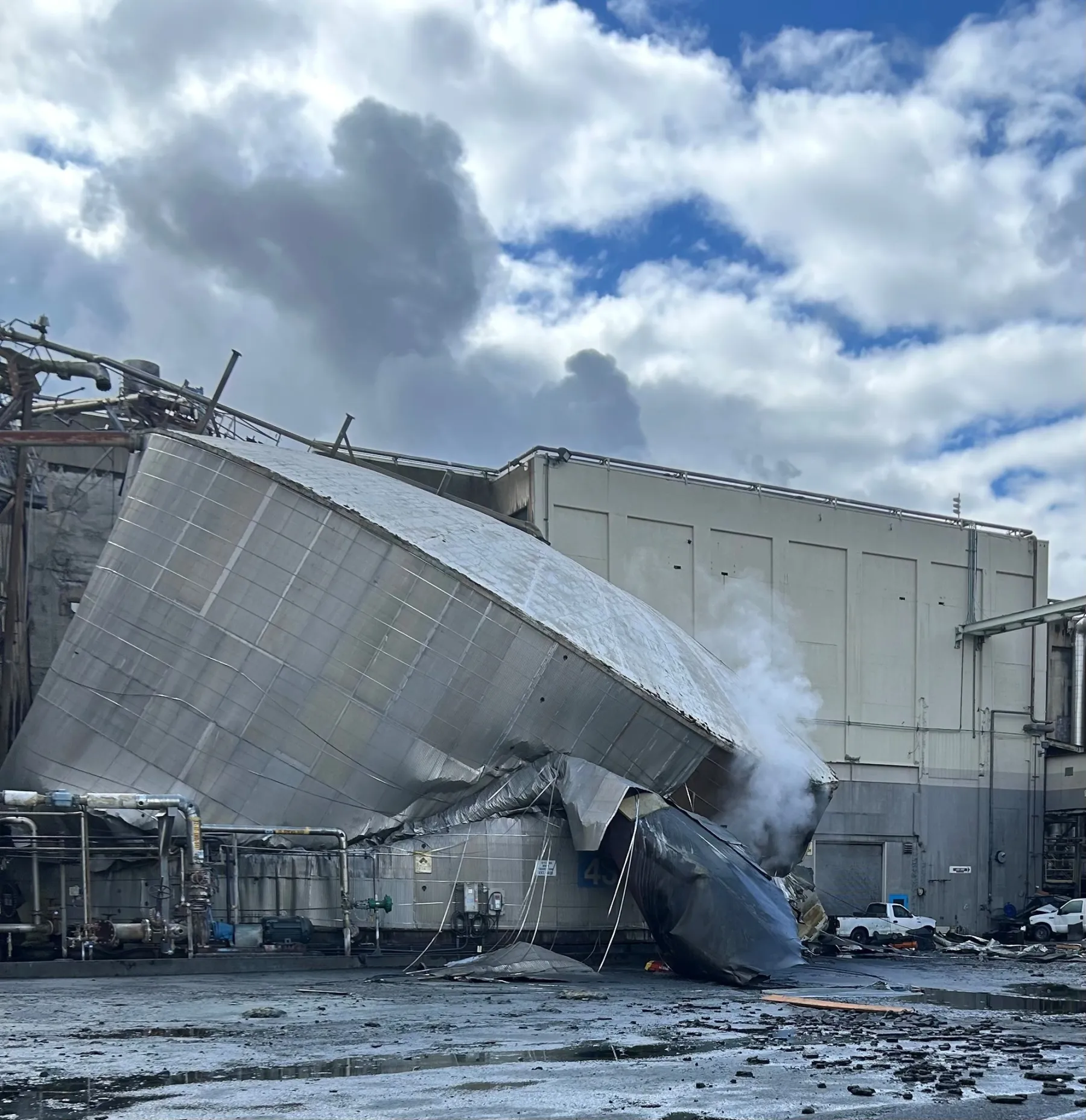
On Tuesday morning in Longview, Washington state (US), an industrial liquid tank burst at a packaging factory, leaving multiple dead and around ten injured. The tank contained about 300,000 litres of a white liquid material and was filled to around 60% at the moment of the rupture.
The factory belongs to Nippon Dynawave Packaging, a subsidiary of Japan's Nippon Paper Industries. The company specialises in producing materials for liquid packaging - the type of cardboard used for milk, juice and similar products. Local authorities said there was „no immediate threat to the environment" - a standard formulation that, in industrial accidents, almost always precedes a revision.
Scott Goldstein, fire service commander for Cowlitz County, confirmed that the exact number of dead has not yet been determined. Ten people are injured, with injuries ranging from minor to life-threatening, including a firefighter.
Washington state governor Bob Ferguson expressed condolences via social media „to the workers, their families and the firefighters." What he did not say - and what matters to any industrial inspection - is what the liquid material actually was. „White" is a visual description, not a chemical one. If the material is toxic or reactive, „no threat" is a statement that can only be confirmed at the end of the investigation.
For the Balkans, industrial accidents in North America remain distant news, but they carry a universal logic - 300,000-litre tanks don't burst on their own. They burst because of corrosion, missed inspection deadlines, or operational error. All three causes are equally possible in our own industries, which is why news like this shouldn't be treated as a foreign curiosity, but as a reminder that certification and regular inspection are not administrative formalities.
The latest 10 news from this category
Washington, Copenhagen and Nuuk are signing off on a military presence on an island of 56,000 people - and the...
Phones in Krāslava rang by themselves, the fighters took off, and what exactly triggered the alert - nobody is saying....
In Mecklenburg the CDU finished on 4.9 percent and, for the first time in the history of the Federal Republic,...

Tisza took 16 years of power off Fidesz and won 141 of 199 parliamentary seats. Orbán now says Brussels is...
With 75 percent of protocols counted, the governing party leads in 208 of the 225 single-mandate districts. A parliament of...

He never sat on the throne, and the emirate is lowering its flags for ten days. Sometimes the surname says...

Three options on the table in Washington - military pressure, economic strangulation or a deal - and the president frames...
The party of Adenauer and Kohl slid to the electoral threshold in Mecklenburg, the AfD is already demanding the chancellor's...

Two prime ministers in the same Union, the same month, completely opposite diagnoses of who is provoking whom. There is...

A broken aircraft in a field usually ends up in a police note. This one ended up with federal investigators,...
This site uses cookies - is that okay? Learn more
Be the first to know when Metla launches something new
Leave your email and we will write when there is a new guide or something new on Metla.