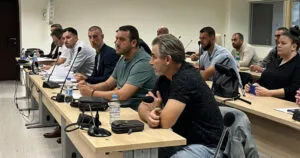
"That's not my job": the trial of the 13 Puls police officers restarted from scratch, and witnesses describe help being refused
22.09.2026


22.09.2026

22.09.2026
22.09.2026

22.09.2026
22.09.2026

22.09.2026

22.09.2026

21.09.2026

20.09.2026

22.09.2026

22.09.2026

21.09.2026

22.09.2026

22.09.2026

22.09.2026

22.09.2026

21.09.2026

20.09.2026

22.09.2026

22.09.2026

22.09.2026

22.09.2026

22.09.2026

22.09.2026

09.03.2026

27.02.2026

19.02.2026

22.09.2026

21.09.2026

21.09.2026

23.04.2026

23.04.2026

12.04.2026


While Silicon Valley throws billions at startups promising that artificial intelligence will answer every question from every customer, a company from Athens has raised $67 million (around €62 million) on the opposite message: most of those questions don't require artificial intelligence at all.
The company is called Omilia and it has been automating phone calls and customer support since 2002. That isn't a small detail - that's twenty-four years in a business most of today's competitors discovered two years ago. The round is led by Expedition Growth Capital and is only the second in the company's history, after $20 million from Grafton Capital in 2020. Since then its annual recurring revenue has grown tenfold, to $60 million.
Chief executive Dimitris Vassos doesn't bother being diplomatic about the competition. "We'll use every available weapon to win the battle for customer service," he says. "Companies like Sierra, Decagon and the rest identify themselves as generative AI firms. Their only goal is to apply generative AI, and that limits them. You can have a bazooka, but if the enemy is close to you, you need a knife."
The argument is more concrete than it sounds. A large share of the calls coming into a contact centre are requests for basic information - account balance, order status, opening hours. That doesn't need a large language model that costs money on every question. Vassos argues this is exactly why Omilia has healthy unit economics both for itself and for its clients, and exactly why it never needed the big capital injections its competitors did.
"Over the next few years we'll see that the companies that survive are the ones offering real return on investment," Vassos says. "We don't mind that we're not as attractive as ElevenLabs and Sierra on LinkedIn right now. What interests us is stable growth and laying the foundations for a billion-dollar-revenue company in the next three years."
The client list keeps that statement standing: Capital One, Discover, RBC, DWP, PSEG. The newest focus is fast food chains that have introduced voice ordering - Taco Bell is already a client, with the technology deployed in over 1,000 outlets, and talks are under way with two more American chains. The company has around 500 employees and expects to reach 600 by the end of the year.
There's also one story Vassos rejects. Last year it was reported that a fault in Taco Bell's ordering system let a customer order 18,000 cups of water. Vassos says it never happened and that Omilia's logs show no such event. Whoever is right, the case shows what automation looks like when it goes wrong - and why a firm with twenty-four years in this field is careful about when to switch the machine on at all.
For a Balkan reader there's more here than another funding round. A Greek company, founded when "artificial intelligence" was an academic term, today bills American banks and runs technology in a thousand restaurants. The path was slow - two funding rounds in twenty-four years is almost impossibly slow by the standards of today's industry. The question that remains is whether that pace is a weakness or precisely the reason the company still exists.
The latest 10 news from this category
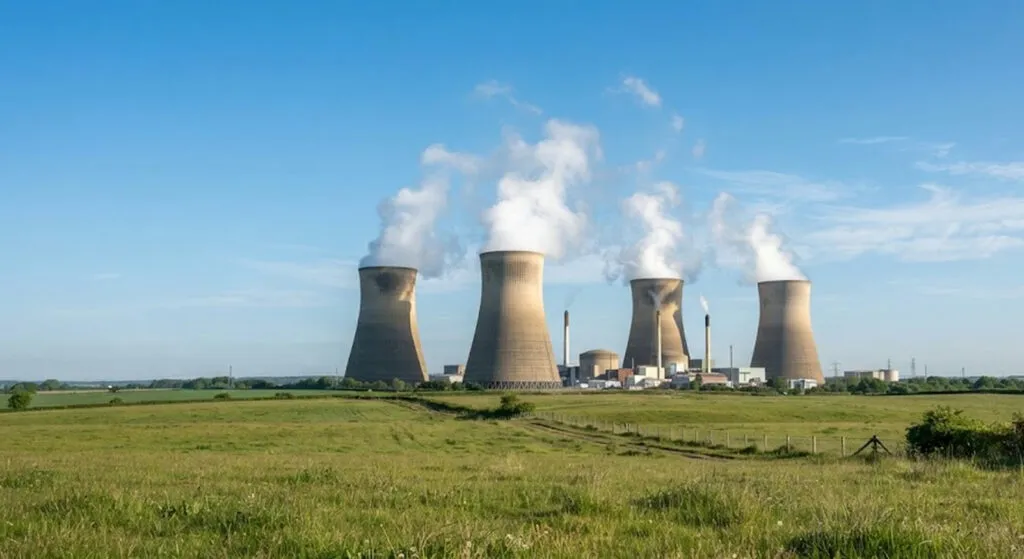
The 50-megawatt reactor is due to start up in 2030, and by 2035 Google wants 500 megawatts. When data centres...
Tinex, SuperTinex, Konto and Spot move to a Pristina-based group with 235 million euros in turnover. The commission saw no...

The WHO has declared loneliness a global health problem linked to around 870,000 deaths a year. On America's east coast...
Porsche, Alaska Airlines and J.B. Hunt are not buying startups - they are commissioning them. When innovation moves inside the...

Sold for two billion, blocked by the state, bought back by its own investors - and now worth twice as...
An eight-year-old firm that started out mining crypto has tripled its value in ten months. It did not discover anything...

The price of uranium has jumped 75 percent in five years, and the list of countries that mine it reads...
Exein raised 270 million dollars and its valuation jumped thirtyfold in two years. The European regulation coming into force in...
A startup valued at 94 million dollars changed hands, and both sides said openly what was being bought - not...
A technology sold for decades as the answer to the climate is now taking money from the defence industry. The...
This site uses cookies - is that okay? Learn more
Be the first to know when Metla launches something new
Leave your email and we will write when there is a new guide or something new on Metla.